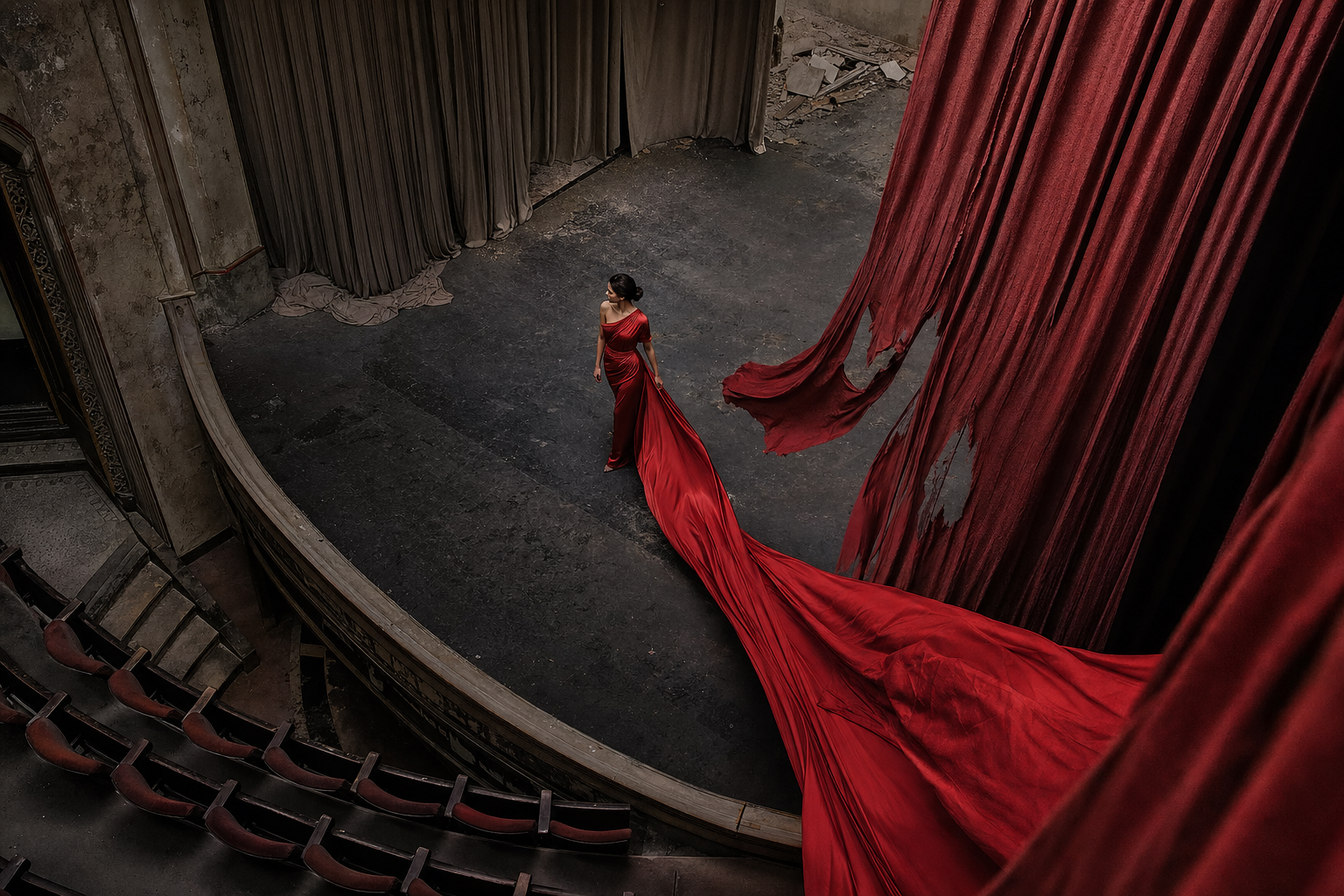
Editorial imagery begins with a proposition
Editorial fashion needs a clearer proposition than “beautiful clothes in a beautiful place.” The collection's relation to a mood, cultural reference or character is stated in one sentence. Location, casting and styling become evidence for that sentence, moving the image beyond decoration.
The rhythm of a photographic sequence
A magazine language is not built from one potential cover. An opening frame establishes the world, full-length images carry silhouette, close views reveal material and transition frames hold atmosphere. The tempo changes across the sequence without leaving the story.
An unusual frame needs a reason
A tilted horizon, severe crop or high viewpoint quickly becomes a trick when used only to look different. Framing should intensify the character's state, the garment form or the pressure of a location, drawing the viewer into the narrative rather than pushing them away.
The product must not disappear inside the story
Editorial freedom is not permission to make the product ambiguous. Key frames retain accurate colour and shape, while experimental images orbit that reliable spine. The series can then serve publication, campaign and brand archive at once.